AI is changing medical billing, and some vendors now pitch it as a replacement for billing staff. It is not. AI is very good at checking data before a claim goes out. It is much weaker at the part of billing that actually recovers money after a claim is denied: reading the situation, calling the payer, arguing the case and fixing the root cause. That work still needs a person.
Here is what AI does well in billing today, what it cannot do, and how to use both.
What AI does well
- Eligibility checks at scale. Running benefits checks for every scheduled patient and flagging inactive coverage or missing authorizations.
- Claim scrubbing. Catching missing fields, invalid code combinations and common modifier errors before submission.
- Coding suggestions. Suggesting codes from documentation for a human to confirm.
- Pattern spotting. Finding which payers, codes or providers deny most often.
- Drafting. Producing a first draft of an appeal letter from the claim and the denial reason.
All of these happen before or around the claim. They prevent errors and speed up routine work. That is valuable, and every good billing team should use them.
Why AI cannot chase a denial
Once a claim is denied, recovering the money usually depends on things that are not in the data:
- Calling the payer. Many denials are resolved on the phone: confirming what the payer actually needs, getting a reprocessing reference, or finding out the denial was the payer’s error. That means waiting on hold, handling transfers and pushing back politely.
- Judgment on the root cause. The same denial code can mean a front desk error, a credentialing gap, a coding problem or a payer system issue. Deciding which one it is takes context from your practice.
- Building an appeal. A strong appeal pulls the right clinical notes, cites the payer’s own policy and explains why the service was necessary. A draft helps. A person decides what to send.
- Working with your team. Fixing the cause often means talking to your providers about documentation or your front desk about intake. Software cannot do that follow-through.
- Accountability. When a claim is stuck at 90 days, someone has to own it until it is paid or properly closed.
The cost of relying on automation alone
Industry studies estimate that 35 to 60% of denied claims are never resubmitted. That is not because practices lack software. It is because nobody owns the follow-up. A tool that flags a denial but leaves it in a queue does not recover a dollar. See what to do when an insurance claim is denied.
The model that works: AI for checking, people for recovering
| Stage | Best handled by |
|---|---|
| Eligibility and authorization checks | AI tools, with a person handling exceptions |
| Claim scrubbing before submission | AI tools and clearinghouse edits |
| Coding | Suggested by AI, confirmed by a trained biller or coder |
| Denial analysis and appeals | A billing specialist, using AI for drafts |
| Payer calls and AR follow-up | A billing specialist |
| Fixing the root cause with your team | A billing specialist and an RCM manager |
Questions to ask any vendor selling AI billing
- Who works the denials after the software flags them?
- Who calls the payer when a claim is stuck?
- What happens to claims over 90 days, and who is accountable?
- What numbers will you show me every month?
How DrBillerz uses AI
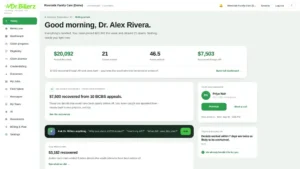
DrBillerz uses automation to check eligibility, catch errors before submission and spot denial patterns. Then a dedicated biller, tested on your specialty and EHR, works every denial, calls payers and follows AR until it is paid, with a dedicated RCM manager reviewing the results. You see claims worked, denials resolved and money collected in the client portal. Billers start from $7/hour, and the first 4 weeks are a free pilot.
Start your free 4-week pilot · Send an enquiry
Frequently asked questions
Can AI replace a medical biller?
Not today. AI is good at eligibility checks, claim scrubbing and coding suggestions, but recovering denied claims still needs a person to call payers, build appeals and fix root causes.
What can AI do in medical billing?
It can run eligibility checks at scale, catch errors before submission, suggest codes, spot denial patterns and draft appeal letters for a person to review.
Why do denied claims go unpaid?
Usually because nobody owns the follow-up. Industry studies estimate 35 to 60% of denied claims are never resubmitted.
How should a practice combine AI and billing staff?
Use AI to check and prevent errors before claims go out, and a trained billing specialist to work denials, call payers and follow AR until it is paid.
Related: Medical Billing VA vs. Specialist: the role distinction that determines whether your billing problem gets solved. Also see India vs. Philippines for Medical Billing.