Cardiology claims are high value and high friction. A single echo, nuclear stress test or cath can be worth more than a day of office visits, and each one comes with component billing rules, prior authorization requirements and global period logic that general billers rarely handle every day. When one of these goes wrong, the denial is not small, and it often repeats across every patient with the same payer.
These are the problems we see most often in cardiology billing, and how to fix each one.
1. Professional and technical component errors
Many cardiology services split into a professional component (the interpretation) and a technical component (the equipment and staff). Echocardiography, stress testing, Holter and event monitoring all follow this pattern. Where the test is performed decides what you bill:
| Setting | What the cardiologist bills |
|---|---|
| Test done in your office with your equipment | Global service (no modifier) |
| Test done at the hospital, you read it | Professional component only (modifier 26) |
| You own the equipment, someone else reads it | Technical component only (modifier TC) |
Billing the global service for a hospital-based test is a common cause of denials and overpayment recoupments. Stress testing adds another layer, because it has separate codes for supervision, tracing and interpretation, and they must match who actually did what.
2. Prior authorization on imaging and procedures
Most commercial and Medicare Advantage plans require prior authorization for nuclear stress tests, cardiac CT, cardiac MRI, PET, and many echocardiograms, often through a radiology benefit manager rather than the plan itself. Authorizations are tied to specific CPT codes, dates and sometimes sites of service.
Three things cause most authorization denials: the test was never authorized, the authorized code does not match what was performed (for example, the order changed from a standard echo to a stress echo), or the test happened after the authorization expired. Each one is preventable at scheduling.
The fix: check authorization status 48 to 72 hours before every advanced imaging appointment, and update the authorization the same day if the order changes. Fix the appointment, not the denial.
3. Modifier 25 and modifier 57 on visit plus procedure days
Cardiologists often see a patient and perform or decide on a procedure the same day. When the visit is significant and separately identifiable from a minor procedure, modifier 25 on the E/M is appropriate. When the visit results in the decision for a major procedure (90-day global) the same day or day before, modifier 57 applies. Using the wrong one, or none, leads to the visit being bundled into the procedure and unpaid.
4. Global period rules after procedures
Procedures carry global periods of 0, 10 or 90 days. Follow-up visits inside a global period are usually not separately payable unless they are for an unrelated problem, which needs its own modifier and documentation. Billers who do not track global periods either lose payable visits or submit unpayable ones that turn into denials.
5. Device monitoring and remote services
Pacemaker, defibrillator and loop recorder checks have their own code families for in-person and remote interrogation, and many remote monitoring codes cover a defined period, such as 30 or 90 days. Billing them more often than the period allows, or billing the professional and technical parts incorrectly, is a steady source of denials in device clinics.
6. Diagnosis codes that do not support medical necessity
Payers publish coverage policies that list which diagnoses support tests like echocardiograms and stress tests. A symptom code that is too vague, or a repeat test without a documented change in condition, is a common reason for medical necessity denials. The fix is on the documentation side, supported by a biller who knows the payer’s policy and flags gaps before submission.
What these problems add up to
Because cardiology procedures are expensive, even a small denial rate on imaging and procedures can outweigh the rest of your AR. When we audit cardiology practices, the largest recoverable dollars usually sit in three places: authorization denials on imaging, component billing errors on hospital-based tests, and visits bundled into procedures by mistake.
For the full picture of what to track, see clean claim rate in medical billing and how to stop prior authorization from slowing your revenue.
How DrBillerz handles cardiology billing
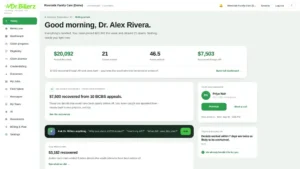
Our cardiology billers are tested on component billing, authorization workflows and global period rules before they are matched to a practice. They check authorizations ahead of imaging, work inside your EHR and clearinghouse, and report to a dedicated RCM manager who reviews denials by category every month. You see claims worked, denials resolved and money collected in the client portal.
Dedicated billers start from $7/hour, and the first 4 weeks are a free pilot. See our cardiology billing services.
Start your free 4-week pilot · Send an enquiry
Frequently asked questions
When should a cardiologist use modifier 26?
Use modifier 26 when you bill only the professional component, such as reading an echo or stress test performed at a hospital on the hospital’s equipment.
Which cardiology tests usually need prior authorization?
Most commercial and Medicare Advantage plans require authorization for nuclear stress tests, cardiac CT, cardiac MRI and PET, and many require it for echocardiograms. Rules vary by plan and are often managed by a radiology benefit manager.
What is the difference between modifier 25 and modifier 57?
Modifier 25 is for a significant, separate E/M service on the same day as a minor procedure. Modifier 57 is for the visit where the decision is made to perform a major procedure with a 90-day global period.
What causes the most expensive cardiology denials?
Missing or mismatched authorizations on imaging, global billing for hospital-based tests that should be professional only, and visits bundled into procedures because of missing modifiers.
Our cardiology billing specialists handle modifier combinations and prior auth follow-up daily. We serve cardiology practices across Texas, New York, and Ohio.