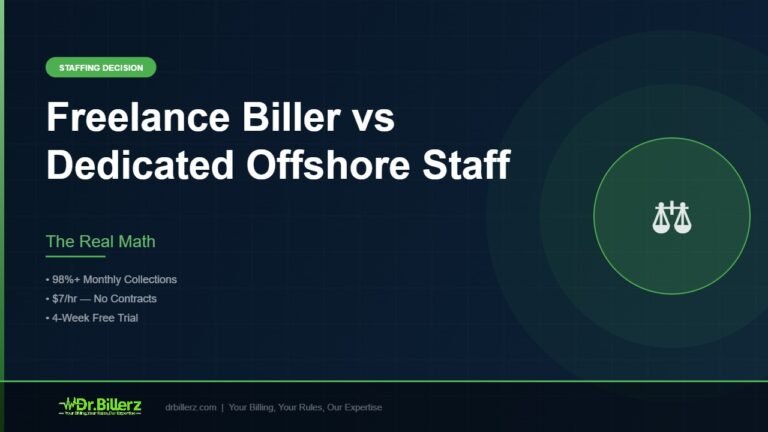
Let us run the actual numbers. Because the decision between a freelance medical biller and dedicated offshore billing staff is almost always made with the wrong math.
Most practices compare hourly rates. That is one input in a much bigger equation.
Why Freelancers Seem Attractive
Post a job, review profiles, start in days. No vendor onboarding, no sales calls, no contracts. The appeal is real.
Here is where the model breaks down.
The 7 Hidden Costs of a Freelance Medical Biller
Cost 1: The management tax on your time
With a freelancer, there is no manager except you. Every payer question, every denial, every missed follow-up comes back to you. Practices report spending 3-7 hours per week supervising freelancers — at a physician’s effective rate, that is $15,600-$72,800 in management time annually. Never on the invoice.
Cost 2: Single point of failure
A freelancer is one person. When they are sick, on vacation, or move to a better client, billing stops entirely. Every week of downtime at a $500K/year practice represents approximately $9,615 in delayed collections.
Cost 3: No root-cause denial management
An urgent care clinic came to us after working with a freelance biller for over two years on eClinicalWorks. Our billing specialist ran a full eCW AR report before we started. What it showed: the same denial codes had been appearing month after month — CO-4 (procedure code inconsistent with modifier), CO-16 (missing information), and PR-96 (non-covered charge). The biller had been resubmitting with small changes rather than investigating why the same errors kept occurring. The root causes were a mix of modifier gaps and payer-specific billing rules the biller either did not know or did not address. Thousands of dollars in the same denial loop, month after month. Once we assigned a dedicated biller and manager, we traced each denial category to its source, fixed the submission workflow, and cleared the backlog within 60 days.
Cost 4: Learning curve on every turnover
Every time a freelancer leaves, you restart. New EHR onboarding, new specialty orientation. Each transition typically costs $5,000-$15,000 in delayed collections and avoidable denials.
Cost 5: HIPAA exposure
Freelancers without a BAA, on personal devices, without training documentation create liability that falls entirely on your practice. Invisible until a breach. Catastrophic when it surfaces.
Cost 6: Hourly billing with no outcome alignment
A freelancer is paid for hours, not results. Whether your collection rate is 75% or 98%, they earn the same invoice. No mechanism connects what they earn to what you collect.
Cost 7: Platform fees inflate the actual rate
Upwork charges freelancers 10-20% of earnings. A $20/hour rate on Upwork represents $16-$18/hour of actual biller time. You are paying for the platform too.
What Dedicated Offshore Staff Looks Like
- A dedicated biller who works only on your practice — same person every day, institutional knowledge that builds rather than resets
- A free dedicated RCM manager who supervises daily, reviews denial trends, catches issues early, and reports to you — eliminating the management tax entirely
- Built-in backup: if your biller is unavailable, the manager covers and a backup activates immediately
- HIPAA-compliant time tracking with screenshot verification — not self-reported hours
- Performance standard: 98%+ collection within 60 days, less than 1% AR past 90 days
Choosing the Right Model
Maximum flexibility: hourly ($7-$12/hr)
Pay for productive hours. Scale up or down as volume changes. Full management and HIPAA compliance included. Best starting point.
One predictable number: flat FTE monthly ($1,200/month full-time)
One number every month. Dedicated full-time biller at a fraction of a US employee’s cost. Part-time option at $700/month.
Incentives fully aligned: percentage model (1-4%)
1% at 95% collection, scaling to 4% at 98%+. Fee auto-lowers if results dip. At $500K collections the maximum you pay at 98%+ performance is $20,000/year — still less than a traditional company charging 7% ($35,000) with no performance accountability.
Surge capacity: pay-for-productivity
Per verified output unit. No permanent commitment. For billing companies needing overflow without adding headcount.
The Math at $500K Annual Collections
| Model | Annual Cost | Mgmt Overhead | Outcome Accountability |
|---|---|---|---|
| Upwork freelancer ($25/hr) | $48,000 + $15K-$35K mgmt | 150-350 hrs/year | None |
| Dr. Billerz hourly ($7/hr FT) | $13,440 | Minimal | 98% benchmark |
| Dr. Billerz FTE flat | $14,400 | Minimal | 98% benchmark |
| Dr. Billerz % at 98%+ | $20,000 (4%) | Minimal | Fee auto-lowers if results drop |
| US in-house biller | $70,000+ | 50-150 hrs/year | You manage it |
Related reading:
Related Resources
- Best Medical Billing Staffing Companies [2026] — 6 companies ranked by price, contracts, and specialty depth
- DrCatalyst vs Dr. Billerz — pricing and contract comparison of the two main dedicated billing models
- Why Upwork Doesn’t Work for Medical Billing — HIPAA gaps and accountability problems with freelancer billing
- How Much Does a Medical Biller Cost? — full 2026 cost breakdown with real numbers
What the Accountability Gap Actually Looks Like
The difference between a freelance biller and a dedicated biller isn’t hours or price — it’s what happens when something goes wrong.
A freelance biller misses a timely filing deadline. You find out 45 days later when the payer rejects the claim. There’s no manager who caught it at day 15. There’s no workflow that flagged the aging claim at day 30. There’s no accountability structure that prevents it happening on the next claim.
A dedicated biller with a free RCM manager overseeing the account has that catch built in. The manager reviews AR aging weekly. Claims approaching timely filing windows are flagged before the deadline. The biller doesn’t disappear into their other clients’ work because they only have one client: yours.
The Performance Numbers
| Metric | Typical Freelance Biller | Dr. Billerz Dedicated Biller |
|---|---|---|
| Clean claim rate | 83–89% | 96–98% |
| Denial rate | 10–17% | Under 3% |
| Monthly revenue collected within 60 days | 85–91% | 98%+ |
| AR over 90 days | 15–25% of total AR | Under 1% |
On a practice billing $80,000/month: the difference between 89% and 97% clean claim rate is $6,400/month in claims that pay first-pass versus requiring rework, appeals, or write-off. That’s $76,800/year — from performance alone, before the cost comparison even starts.
When a Freelance Biller Actually Makes Sense
For a short, defined project — cleaning up a specific batch of aged AR, auditing 90 days of claims for a specific denial pattern, a one-time credentialing task — a freelance biller can work. The engagement is defined, the scope is contained, and the accountability gap has limited damage potential.
For ongoing billing — daily claims submission, denial management, AR follow-up, prior auth tracking — the dedicated model consistently outperforms the freelance model on both cost and accountability. The free 4-week pilot makes the comparison concrete: you see the actual clean claim rate and collections data before you commit to anything.
Related: The Full Upwork Medical Billing Research
Upwork medical billing: what practice owners actually find | Upwork medical billing cost vs. dedicated staff | Best Upwork alternatives for medical billing | Why Upwork fails for medical billing | Freelance biller vs. dedicated staff
Related: Medical Billing VA vs. Specialist: The Full Comparison